Sunday, September 7, 2014

My Confession, Part 2: I Am Saved by the MTBoS

    This poster is displayed prominently in my room.


     I tell my students that it's there to provide them with encouragement and hope, but really it's there for me.  It gives me comfort, even though I highly doubt Einstein had the type of dysfunctional relationship that I have had with math.

    Several years ago I was plucked out of out of my elementary classroom, where for over 20 years I taught reading, writing, science, social studies, health, and, yes, math to 7 and 8 year olds.  I put up bulletin boards, made sure everybody got cupcakes and juice on birthdays, planned and took field trips to zoos and museums, drew smiley faces on papers, filled out report cards, did the million things, both large and small, that all elementary school teachers do.  And then one September it was over.
    I was given the title "math specialist", a title that made me cringe, because my mathematical ability is by no means special.   But as long as the math didn't get too difficult, I had no doubts about my ability to help struggling learners.  In fact, I felt I had a small advantage; I could empathize with their struggle and perhaps be able to re-teach and explain concepts in ways that might make sense to them. For inspiration I looked to a familiar world, the world of sports.  I could be like Charlie Lau!

A mediocre hitter himself, Lau (right) is considered the most influential hitting coach in the history of Major League Baseball.  His disciples included Hall-of-Fame third baseman George Brett, a lifetime .305 hitter.

      I spent the first several years in my new position mostly pulling kids, both individually and in small groups, out of their classrooms and back to my room for one-to-one and small group instruction.  We call this "basic skills".  I was patient. I was sympathetic.  I took out manipulatives.  We did journal pages together, maybe got a start on the homework.  We studied for unit assessments.  I did what I could to patch them through a curriculum that raced relentlessly forward and never slowed down long enough for them to catch up, then sent them back into the inferno.
    Two years ago, something happened that changed everything.
   One day,while surfing the internet for math resources, I followed a link to Dan Meyer's TED Talk: Math Class Needs A Make-Over.  There's a powerful sequence when he shows a page from a textbook...

Just looking at it made my eyes glaze over and gave me a familiar sinking feeling in the pit of my stomach.

 ...and then strips everything away until he's left with just the visual of the chairs going up the lift.


   "Which section do you think is the steepest?" he asks.  That was a question I could answer.  It was a question anyone could answer.  You could just eyeball it and make an intuitive guess; you didn't need any "math".  I was hooked: how would we find out?  If there was math that would help answer that question, then that was math I wanted to learn.  Very powerful stuff for a kid who just wanted to crawl under his desk during math class.  I replayed the video over and over, and from there went straight to his blog, started at the beginning, and began reading.  I became convinced that if he had been my math teacher, things would have been much different, and realized that what I had been doing wasn't really teaching.

   Next came Paul Lockhart's  A Mathematician's Lament.

 I remember reading it and thinking, "This must what it would've been like to read a samizdat in the post-Stalin USSR." I imagined math teachers passing worn and dog-eared copies to each other, one step ahead of supervisors waiting to confiscate the manifesto and denounce them as heretics.  I just couldn't believe that a real, honest-to-goodness math teacher would write something that was so damning of his profession and that so accurately captured my learning experience.   I wanted to cry when I read this:

...if I had to design a mechanism for the express purpose of destroying a child's natural curiosity and love of pattern-making, I couldn't possibly do as good a job as is currently being done-I simply wouldn't have the imagination to come up with the kind of senseless, soul-crushing ideas that constitute contemporary mathematics education. 

    It would be hard to overstate what this meant to me.  It meant that I had, somewhere buried deep inside, an ability to do math.  Maybe it was small, but it was something that could be nurtured and, given the right conditions, it could grow.   It had been crushed out of me all those years ago, but with some help it could be found again.
 
   I suppose I followed a well-worn path: from Dan, who taught me about 3-Acts and intellectual need; to Andrew, whose work at estimation180 has had the biggest impact on my practice; to Fawn, whose humor,  humanity, and creativity  has helped me keep my eye on the ball; to Michael,  whose relentless and passionate search for meaning inspire me to dig deep; to Graham, an elementary compadre who keeps me company in a middle- and high school world.  And there are many others.  I took Jo Boaler's course, and learned about Carol Dweck's growth mindset research.  So it was true.  I could learn, not just how to do math, but maybe even to like math.  And if it was true for me, it could be true for all those other strugglers out there: the finger counters and the red x'ers, the fraction flunkies and the long division losers, the times table fist bangers; the confused, the lost, the drowning, and the already drowned.
   So I joined a wild and wonderful community called the MTBoS. I lurked.  I started commenting on other people's blogs.  I started my own.  And I've grown more as a professional in the past two years than in the previous 25 combined.
   There is another, smaller picture hanging in my room.


   This one has been with me since my first years teaching.  But it has taken me all this time to realize that the words apply just as much to me as they do to my students.  We no longer have to use our imaginations to envision what engaging, exciting, and nurturing math classes can look like.  The teachers who are embracing and exploring new ways to make math meaningful in their classrooms are taking no small amount of risk.  But they are doing no less than what they expect of their students.  I am proud of them, and proud to be counted in their number.
    School's in.  It's time to get back to work.

Thursday, August 28, 2014

My Confession, Part 1: I Undergo Mathematical Trauma

   I was never good at math.  My struggle, my inability to get it, has colored my feelings toward the subject, feelings which remain even today.  It started early on:

This is from my first grade report card.  My parents saved lots of things.

      Towards the end of my second grade school year we moved, and I enrolled in the neighborhood elementary school for the final few weeks.  The teacher figured me out real fast:

I eventually learned how to tell time.

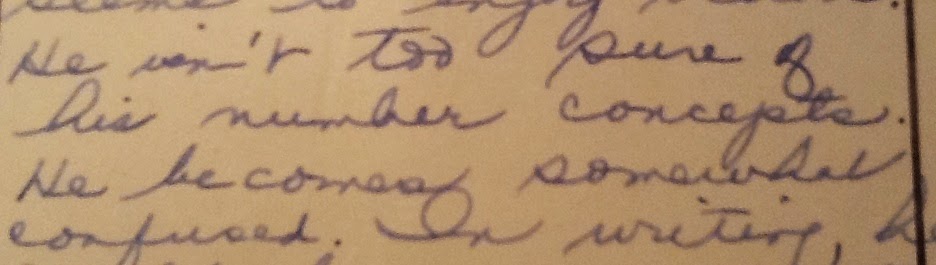
     Things never got better.  I never caught up, never caught on, and I suppose this is when my confusion turned to feelings of inadequacy, fear, anxiety, and hostility.  Here's  a work sample from grade 4:


4 out of the 7 problems are marked incorrect with a red "x".
How's that for meaningful feedback, Michael Pershan?


(It's funny what you remember.  It must have been in this class that the teacher asked us to put long division problems on the board for our classmates to solve.  When it was my turn, I wrote something I supposed would be really difficult, with 99 as the divisor.  99 seemed like a "hard" number to me.  The girl who was chosen to solve the problem laughed, "99 is easy to divide.  It's close to 100."  I didn't get it.)
 Again, my math warranted a report card comment:

The "of course" really stung.  This was doubly devastating because I had a crush on Mrs. Hughes.
Despite her hopefulness, it didn't improve.
  Things degenerated in middle school, and I am thankful those report cards have gone missing.  I suppose things culminated in my algebra 2 class in high school:

I was fortunate to get Ds; Mr. Momberg felt sorry for me.  I know I took geometry and trigonometry in high school, but that's as far as I got.  I planned to get as far away from math as I possible could.


  The idea to explore my personal relationship with math comes from an assignment in a course I should have signed up for:  Justin Lanier's smOOC Math is Personal.   It also arises from feelings I have about becoming a more active member of the MTBoS, and connecting with people who come from mathematical backgrounds very different from my own.  But what actually got me digging up my old report cards was reading a recent post from Fawn Nguyen, who shared excerpts from a book called The Number Sense, by Stanislas Dehaene.  This one jumped right off the page:

… most children enter preschool with a well-developed understanding of approximation and counting. In most math courses, this informal baggage is treated as a handicap rather than as an asset. Finger counting is considered a childish activity that a good education will quickly do away with. How many children try to hide when they count on their fingers because “the teacher said not to”?
Despising children’s precocious abilities can have a disastrous effect on their subsequent opinion of mathematics.
… It seems more likely that many of these “mathematically disabled” children are normally abled pupils who got off to a false start in mathematics. Their initial experience unfortunately convinces them that arithmetic is a purely scholastic affair, with no practical goal and no obvious meaning. They rapidly decide that they will never be able to understand a word about it. The already considerable difficulties posed by arithmetic to any normally constituted brain are thus compounded by an emotional component, a growing anxiety or phobia about mathematics.

     That was me, the kid hiding his fingers behind his back.  The kid with his head buried in his book, pretending he knew what he was doing and praying not to get called on.
     So it is ironic that I find myself in my current position, which I suppose goes to show that you really never know where life will lead.  And I am now part of a community where sometimes people talk like this...


...and I haven't much of a clue what they're driving at.
    But it is that same MTBoS that has made me see that it just doesn't have to be that way, something I describe in My Confession, Part 2.


Tuesday, August 19, 2014

Don't Worry So Much

       Reading Chris Lehmann's post about encountering former students as adults has inspired me to share some thoughts.  He's absolutely correct: one of the great things about teaching is that, if we hang around long enough, we sometimes get to see the adults our former students become.  "The perspective of seeing students become adults," he writes, "Can powerfully inform the way we teach."
     True story:  One of my first years teaching, over 25 years ago now, I had a student I’ll call Jennifer.  Jennifer was a very sweet second grader, but she struggled academically.  She was reading below grade level, her writing was poor, and she lacked many basic math skills.  As the year progressed she fell further and further behind.  I was really worried about her.  She may have been the first student I brought before our Student Assistance Committee, and she was eventually referred to our Child Study Team, who recommended she be evaluated.  When her father came in to sign off on the eval plan, he turned to me with the pen poised over the dotted line and asked,
     “Mr. Schwartz, if she was your daughter, what would you do?”
What did I know?  I didn't have kids.  I was in my mid-20’s, single, only few years out of school.  His question left me flustered.  I felt this weight of responsibility, as if her entire future was riding on my response.  I don’t recall exactly what I said; I but know I fumbled around uncomfortably.  And I think he sensed my worry and uncertainty, because after he signed, he looked back at me and said,
     “It’s OK.  She’s going to be fine.”   I was relieved, but couldn't help thinking, “What does he know that I don’t know?”
    Flash forward: Just a few years ago I was standing outside school one afternoon on bus duty.  As the last bus pulled away, a black Mustang rolled up to the curb.  It was Jennifer’s brother, who I had also taught when he was in second grade.  After catching up with him, I asked about Jennifer, thinking back to that day when her father asked me that very important question.
 “She doing great,” he told me.  “She’s a nursing student at Rutgers.”  I could only smile.

   Around the same time that I learned about Jennifer, I found myself sitting with my wife across the table from a different Child Study Team, in a school not my own, signing off on an eval plan for our daughter.  She had struggled for much of her elementary school years, and her fourth grade teacher was very worried.  Her test scores were bad.  She was reading below grade level.  Her writing was poor.  And don’t even ask about her math.  I told her teacher over and over again, “Don’t worry so much.  She’s going to be fine.”  I knew this because I knew some things about my daughter that her teacher didn't know: that she had nursed a grandmother dying of cancer and never flinched; that she could command a room full of three year olds better than many teachers at my wife’s pre-school; that she conquered a fear of animals and learned how to ride a horse and jump over a fence.  I knew my daughter was an amazing child, with talents and abilities that her teachers had no idea she had.  They were worried because her test scores were low.  I knew she had attributes that no standardized test could ever measure.  She had courage, persistence, and empathy.  I could see into the future.  I knew what Jennifer's father had known.  I could see the adult she was destined to become, and I thought about Jennifer, and knew I was right.

      The perspective of seeing students become adults can powerfully inform the way we teach.
      Can we also say that the ability to imagine our current students as the adults they will become is equally as powerful?  I think so.
      How does it inform the way I teach?  Because I only see my students in school, I need to resist the temptation to define them by their “school selves”; their school behaviors and the work they produce.  With the intense focus on testing and its high-stakes implications, it's often hard to do.  But these are narrow definitions, and the kids I teach are much more than the sum total of their test scores.  They have strengths and abilities that I never see.  So instead of trying to cram all the math I can into them in the limited time I have with them, I try to set aside time to talk: in the hallway on the way from their classroom to my room, over a game we play once we arrive, on the playground when I’m on recess duty, in the all-purpose room during line-up when I’m on morning duty, or just sitting at a table.  Just to show them I’m interested in what they’re interested in.  Even the ones who don’t deserve it.  And when I help teachers plan projects and activities, I try to allow for means of expression not normally associated with a math class: writing, art, and sports, something I want to do a better job of this year.
     Anyway, it's not exactly news that the nature of the student-teacher relationship has profound implications for learning.  David Kirp put it well in his op-ed piece last Sunday.  The process of teaching and learning is, "an intimate act... (full of) complicated and messy human relationships."
   I am blessed to be able to have taught as long as I have, because it has given me the opportunity to see former students grow into adulthood.  And I am thankful for Chris Lehmann's post.  As I contemplate the beginning of a new school year, he reminded me that I must first connect to my students as one human being to another.  If some math sneaks in, that’s just icing on the cake.


Wednesday, August 6, 2014

Making a Big Thing Out of it Would've Been a Good Idea: Practice Standard #6

   Is there a better example of the importance of  Math Practice Standard 6, Attend to Precision, than the Stonehenge fiasco in Rob Reiner's classic "rockumentary" This Is Spinal Tap?
     As the band's tour starts to disintegrate, lead guitarist Nigel Tufnel (Christopher Guest) suggests
resurrecting their famous "Stonehenge" stage act.  Lead singer David St. Hubbins (Michael McKean) is skeptical; they no longer have the required scenery.  Nigel insists, and begins sketching on a napkin as Ian (Tony Hendra), the band's manager, looks on.

"So we build a new one.  And this is it, look!"


Ian:   Consider...consider it done.
David:   So you're just going to take care of it like that.  You're going
         to find someone to design it...using that as a plan?
Ian:     Let's try.  Let's try.
David:   If you can do it, I'll do the number.

When Ian receives delivery, he is quite surprised:

Ian:    This looks actually perfect. I mean it's, uh, the right
        proportions.  It'll be this color right?
Artist: Yeah. Yeah.
Ian:    Yeah.  That's...that's...that's just terrific. It almost looks
        like the real thing.
Artist: Well good.
Ian:    When we get the actual, uh, set, when we get the piece,
        it'll...it'll follow exactly these specifications. I mean even
        these contours and everything?
Artist: Um, I'm not understanding it. What do you mean "the actual piece?"
Ian:    Well I mean...I mean when you build the actual piece.
Artist: But this is what you asked for, isn't it?
Ian:    What?
Artist: Well this is the piece.
Ian:    This is the piece?
Artist: Yes.
Ian:    Are you telling me that this is it?  This is scenery?  Have you
        ever been to Stonehenge?
Artist: No, I haven't  been to Stonehenge.
Ian:    The triptychs are...the triptychs are twenty feet high.
        You can stand four men up them!
Artist: Ian, I was...I was...I was supposed to build it eighteen inches high.
Ian:    This is insane.  This isn't a piece of scenery.
Artist: Look, look. Look, this is what I was asked to build. Eighteen
        inches. Right here, it specified eighteen inches. I was given this
        napkin, I mean...
Ian:    Forget this!  %#@*  the napkin!!!


Unwittingly, the band goes onstage to perform.  As it is lowered to the stage at the climactic point in the song, they stare in disbelief as dwarves dressed as druids dance around the model.


After the show:
David:   I do not, for one, think that the problem was that the band was
         down.  I think that the problem may have been...that there was a
         Stonehenge monument on the stage that was in danger of being
         crushed by a dwarf.  Alright?  That tended to understate
         the hugeness of the object.
Ian:     I really think you're just making a much too big thing out of it.
Derek:   Making a big thing out of it would've been a good idea.
Ian:     Nigel gave me a drawing that said eighteen inches.  Alright?
David:   I know he did, and that's what I'm talking about.
Ian:     Now, whether he knows the difference between feet and inches is not
         my problem.  I do what I'm told.
David:   But you're not as confused as him are you?  I mean it's not your
         job to be as confused as Nigel is.

I'd like to acknowledge Matthew Petty, a systems engineer who blogged about this last September.  I came across his post while looking for some pictures for mine.  (Thanks Matthew!)  He draws from this a lesson in Requirements Management, which he describes as, "How you ensure that what you build corresponds to what the customer is asking for."  Certainly a relevant "real world" application, whether we're the customer or the designer.
  Of course, mathematically speaking, all is not lost for Nigel.  While he may not know the difference between feet and inches, he does know that eleven is one more than ten:


Wednesday, July 30, 2014

Summer in New Jersey, or What in the World is Sitzfleisch?

It's summer here in the Garden State.  That means:

These are amazing.  No tomato in the world comes close.
White, yellow, bi-color,,,it's all so good.

And of course:

Healthy doses of "the Boss".

     Summer also means it's time for two weeks of PD with over 60 math teachers from all over central New Jersey at the Mid-New Jersey Math-Science Partnership (MSP) on the campus of Middlesex County College. I've taken advantage of this PD opportunity 2 out of the past 3 years, and its quality has been uneven.  But judging from our first few sessions, I think that this year's session will be different.
   One of our first assignments was to take a look at several recent articles and compose some reflections and thoughts.  Elizabeth Green's piece in the New York Times Magazine section has gotten lots of attention. In fact  Dan assigned this for summer reading last week.  We were also given copies of Jordan Ellenberg's Times op-ed, "Don't Teach Math, Coach It".  Ellenberg advocates using games, both classic (chess, board games, cards) and new (an app called DragonBox) to teach kids sitzfleisch, which in its traditional sense means the ability to sit still and concentrate for an extended period of time, but which Ellenberg defines as, "the ability to focus on a complicated skill for the length of time it takes to master it."  Because games can be addictive, Ellenberg believes they can play an important role in building sitzfleisch, which in turn can promote attentiveness, doggedness, and perseverance, all good qualities any learner should develop.  Perseverance even pops up in the Common Core's first standard for mathematical practice, "Make sense of problems and persevere in solving them."
     I've blogged about games before.  From Ultimate-Tic-Tac-Toe, to an in-depth exploration of Factor Captor, to having the kids create their own games.  But I've always thought of them as skill reviewers or problem-solving experiences, not as sitzfleisch builders.  Here's one that Ellenberg recommends:

This game is called Rush Hour.  The object is to move the cars around so that the red car can exit the parking lot.  Ellenberg claims that this game is about search algorithms; I've used this quite a bit this year, especially with one or two especially impulsive third graders.

 
      I don't know anything about search algorithms, but it was gratifying to see the kids grow in their ability to stick it out until they find a way to solve the puzzle.  Often the solution requires them to take two steps forward and one step back before they can move forward again, itself an important problem solving skill.
    Here's another favorite:

Mancala is a go-to game.  Easy to learn, and it doesn't take very long to complete.  But you need to be able to think ahead and play out moves in advance in order to be successful.  And the colored stones are cool.

     Again, I have seen impulsive kids, who start by randomly choosing a cup and dropping stones, learn how to think before they act.  This a behavior that can be transferred back to the classroom and used in a traditional learning and practice environment.
     Here at MSP Dr. Milou has encouraged us to explore on-line game sites that promote computational fluency, like arcademics.com and sumdog.com.  They build sitzfleisch too.
    So fire up the BBQ, put up the corn, cut up a big Jersey beefsteak tomato, put on some Bruce, and go forth and play a game!

Summer's here and the time is right...


Friday, June 13, 2014

"The world would be a great place if we could play Factor Captor all day long."

     Factor Captor is an Everyday Math game designed to help students practice identifying factors and multiples, and explore prime and composite numbers.

The rules are not as complicated as they look.  

Here's a close-up of the board.   Jeff and I decided to use Grid 1 (Beginning Level).

   We introduced the game to the fourth graders in October, at the beginning of our first multiplication unit.  It took a few days, but eventually the kids got the hang of it.  We encouraged them to use multiplication tables to find factors, and made a solemn vow not to use the words prime or composite.  We just let them play and hoped that at some point they would come to the realization that some of the numbers had more factors than others.


      One day, about a week after we had introduced the game, I was walking around the room with my iPad  and decided to record some kids playing a round.  I got about 5 minutes of video, and later watched it during lunch.  Knowing how much they like to see themselves on TV, I played it for the class the next day.  As the kids watched the action, something occurred to me: why don't I use it like a coach would use game film?  So before the next move was made, I hit the "pause" button.
    "What do you think the next move will be?" I asked.  There were lots of opinions as to what the best next move was, and I made sure that each one was backed up by some type of explanation.  The idea that there was some strategy involved, which some kids had already begun to intuit, was brought out into open discussion.  And after everyone who wanted to had a chance to express their opinion, I just hit "play" and we saw what actually happened.  The kids loved it!  So we continued in this way for several turns, and came back to it the next day with more video.
    This is when I began to think that maybe we should push this game a bit more.  At the very least the kids were getting practice with some multiplication facts (3 x 9 = 27 was pretty much automatic by that point), they were also adding (as they kept score), and of course continuing to build some understanding about factors and multiples.  Besides, they were still having fun with it.
  A look at a random notebook page where two kids had kept score of a game they played gave me another idea:


How easy would it be to recreate a game based on a copy of the score sheet?  
     Jeff and I tried this ourselves one day at lunch.  It wasn't so easy.  Some of the numbers on the page represented a first number selected, others represented factors or factor totals selected in response, and others represented running cumulative score totals.  We weren't sure how the kids would respond, but we decided to give it a try.
     This got frustrating for some as there were often several false starts, and kids were confused as to what the numbers actually meant.  But the majority were able to piece together at least the beginning moves of the game.
    Of course next came the reverse: Given a picture of a board from a game that is already in progress...


...can you recreate the score sheet?


     By this time the unit was nearing its conclusion, the assessment was just days away, we still hadn't introduced the terms prime and composite, and Jeff was starting to panic.  So we decided to have another class discussion about Factor Captor strategies.  It was centered around numbers that were "good to pick".  By this time the kids knew that 11 and 13 were good because they had no other factors except 1 and themselves.  In fact, in most games, 11 and 13 were the first numbers selected.  This is how we organized the concept of a prime number.  Other numbers might be more or less "good to pick", but they had other factors besides 1 and themselves.  So that's how we organized the concept of a composite number.  Jeff was relieved.  And the unit drew to a close.
   At this point we would have put the game away.  The next unit dealt with fractions, and so did the one after that.  No need for factors and multiples, prime and composite numbers anymore.  But Jeff and I decided we wanted to continue to explore the game with the kids, and that these explorations could take place in and around other lessons and activities.
  Circling back to our conceptions of primes and composites in relation to the game, and the strategy involved in playing, I thought it would be interesting to see if the kids could classify the numbers on the board as "really good", "kind of good", or "not so good", and give a reason to back it up.  The fact that they would have to cut up a board appealed to my sense that if you want to understand something, it's a good idea to take it apart.


Jeff and I liked this explanation.
These kids understood that the classification would have something to do with the point differential.

Here's what we were driving at: what's the point differential?  These kids nailed it for 27.

   After spending several days working on this project, we decided to let them play the game again, this time using their charts.  We asked them to keep in mind whether or not their charts were helpful, and whether some numbers might be classified incorrectly.
     My supervisor came to observe me in December.  I wanted to use the observation as a chance to showcase some of the different projects and activities we had been exploring in grade 4.   We started with a homemade estimation 180 activity, and then divided the class in half.  Some were working on the highway sign project, and others playing factor captor and working on their strategy posters.  He liked the game, and noticed how engaged and excited the kids were.
  "The world would be a great place if we could play factor captor all day long!" he said wistfully.
  It's now June.  And Jeff and I have made it a point to integrate the game into our guided group routine at least twice a month. This has provided another opportunity for us to reteach, conduct formative assessments, and have the kids revisit the skills and concepts.

As they have played, their strategy posters have been amended, edited, and revised.

Some have needed more paper!
 
     Jeff and I agree that the strategic use of games like Factor Captor, and the Pie Eating Contest, must be an integral part of our program going forward.  These games have the potential to be repurposed, taken apart, and mined for their rich content.  They have too much going for them to be played just once or twice and then put away.


Wednesday, June 4, 2014

Lights, Camera, Estimate!

Readers know that Andrew Stadel's estimation180 site has had a tremendous influence on our teaching practice.  Thus far we've concentrated our efforts in grade 4.  We have of course mined Andrew's site, and Theresa and I have created our own activities, but in order for us to build up a stock-pile to use with other grade levels, we've needed some help.  After reading about Jonathan Claydon's amazing "Estimation Wall", I realized we had a work-force right here in house: the fourth graders! So I had Jeff put his Newhouse degree to work setting up our own "Estimation 180 Studio".  He helped me design a proposal sheet:

We made these available for the kids to describe their tasks.


Jeff and I felt that it was important that the student(s) who wrote the proposal also compose and take the actual shots.  Here is a final product:
The question.


The reveal.


In this proposal, the student visualized the tissue box, "with one sticking out."


Many students want to use video.  Unfortunately, our studio is not very high tech (No-tech, really.  It's my room and an ipad.) And we do not have Andrew's videography skills.  For example, when I explained to the student who submitted the tissue proposal that it would take too long to film her counting out all 144 tissues, she said, "You can just speed it up!"   Well, no.  At least not yet.


We decided to alter the proposal, using a post-it rather than a notebook as a referent.


We have managed to pull off some videos.  "Erasers in a Cup" took four takes!


IMG 0967[1] from Joe Schwartz on Vimeo.


IMG 0957[1] from Joe Schwartz on Vimeo.

We have more in the production pipeline, and one of my goals this summer is to improve my video skills.  Involving the kids in the process is a win-win: they get a chance to create, we build up a bank of tasks to use with other grade levels, and everybody walks away happy!