Thursday, February 26, 2015

Hey Look! I Made a 3-Act!

     I suppose it was bound to happen.  After two years of covering other people's material, I finally made my own 3-Act.  The inspiration came from an unlikely place:

Actually I've found quite a bit of math in here.

  It was in the middle of a 2-week, 6 classroom tour of Lisa Anglea's  Piggy Bank 3-Act  (it's in Grade 3, Unit 1, pgs. 58-64) that I noticed this:

It was sitting on one of the tables in the Faculty Lounge.  
   I felt it had the potential for a 3-Act task similar to Piggy Bank, except instead of finding out the number of coins in the bank, the kids would work on finding out how many packets of sugar and sweetener were in the basket.  And as a sequel, they could calculate how much sugar and sweetener there was.
   I didn't have time to work it all out at the moment, so I took the basket back to our room. Teachers would have to go without sweetener for a while, but it was all in the name of math.  As I began to look at the packets, I realized they were all different brands: Dunkin' Donuts, Wawa, name brand, generic, etc.  I felt that for the task to work, each type would have to be the same.


A quick trip to the supermarket and I had what I needed, and the teachers had their sweeteners back.

Act 1


sugar act 1 from Joe Schwartz on Vimeo.

Here's a picture of the packets in a pile:


Act 2


   This move was informed by my experience with Piggy Bank.  During Act 2 a group in one class had asked to see, "All the coins laid out in a line."  What an interesting experience it would have been to watch the members of that group attempt to count 814 coins!  So rather then just give them the total number of each type of packet, I decided to make them work for it.  I also felt it would be a good way to reinforce arrays and multiplication.
   As I worked the Piggy Bank 3-Act through the classes, I was surprised by how many requests I received for the dimensions of the bank.  I tried to anticipate this happening with the sugar 3-Act, so I took this picture just in case:


    And for the sequel:


Act 3
   
   If you're keeping track, it's 40 packets of Domino, 26 Sweet 'n Low, 21 Equal, and 25 Splenda for a total of 112 packets.


 For the sequel reveal, I need to give credit to our district's videographer John McMenamin, who has helped give some of our videos a more professional feel.  Warning: Even with the time lapse, the video runs a little over 5 minutes.  For those unwilling to sit through it, a picture follows, although I think counting by 3 1/2 would make a good counting circle activity.


SugarREVEAL from Joe Schwartz on Vimeo.


Here's what I learned:
  • It's not so easy to make a 3-Act, and it really helps to have people to collaborate with.  Kudos to my ace film crew.  Thanks Theresa and John!
  • Previous 3-Act experiences can help you anticipate what the kids may ask for in Act 2.  The more information you can provide in Act 2, the better the experience.  
  • 3-Acts are contagious.  Once you do one with your class, it's hard not to see the world around you in terms of potential 3-Acts.  Theresa created one from a picture she took at a birthday party of a 4 ft. sub sandwich for grade 5, Rich already has one under his belt and is working on another, Jane is hammering out the details on a Lego 3-Act for grade 3, and Kim has some ideas for 3-Acts for kindergarten.
 We've yet to spring this one on a class, so if you try it, please give us some feedback in the comments.  


Thursday, February 19, 2015

Building a Better Worksheet

     "So 90 percent of what I do with my five hours of prep time per week is to take fairly compelling elements of problems like this from my textbook and rebuild them in a way that supports math reasoning and patient problem solving."
     Dan Meyer, Math Class Needs a Makeover


     Fair or not, worksheets, like textbooks, have a bad reputation.  They conjure up images of quiet students sitting at desks in orderly rows, filling in blanks and bubbles.  Busy work.  But with a bit of imagination, along with some cut and paste, we can transform them into something a little more meaningful.  Here are two recent attempts:
   
Example 1

     Our district uses Everyday Math.  One of the nice features of its online component is access to differentiated worksheets.  Searching for something to use with the fifth graders to complement our fraction work, I came across this:


     I liked the idea behind this one.  I had heard from both Bill McCallum and Phil Daro at the AMTNJ conference in October that one of the intentions behind the Common Core standards was to emphasize mental math, number sense, and estimation by benchmarking, and I felt these questions hit that target.  But there were some things I didn't like.
     What first caught my eye was the title:


     Why tell the kids that these are addition problems? Let them figure out what operation to use.
I cut it.  Next, the directions:


    Why tell the kids what strategy or tool to use?  Let them figure it out!
I cut it.  Left with more space, I moved the questions up and added boxes to give them space to explain their thinking.  Here's the final product:


Example 2:

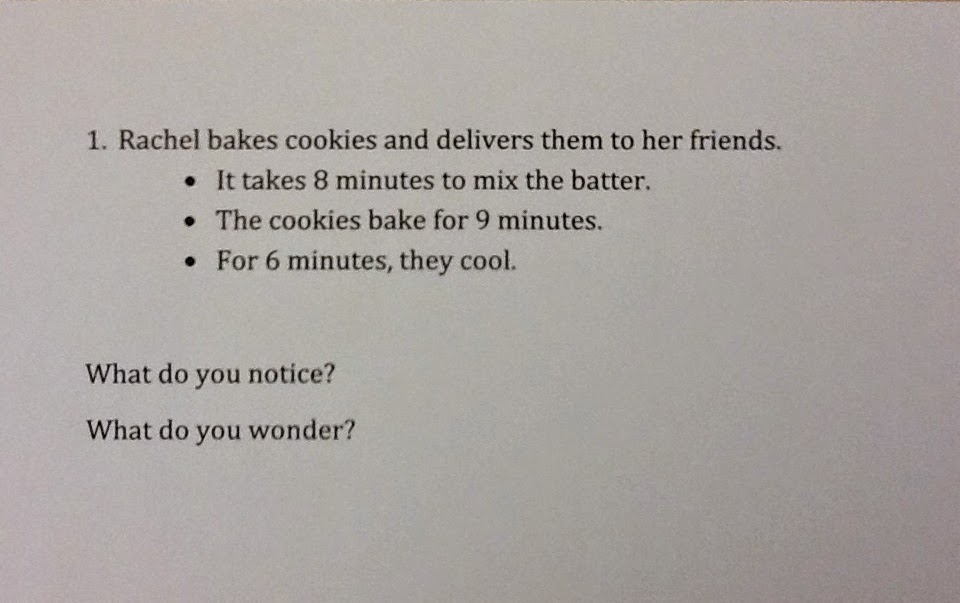
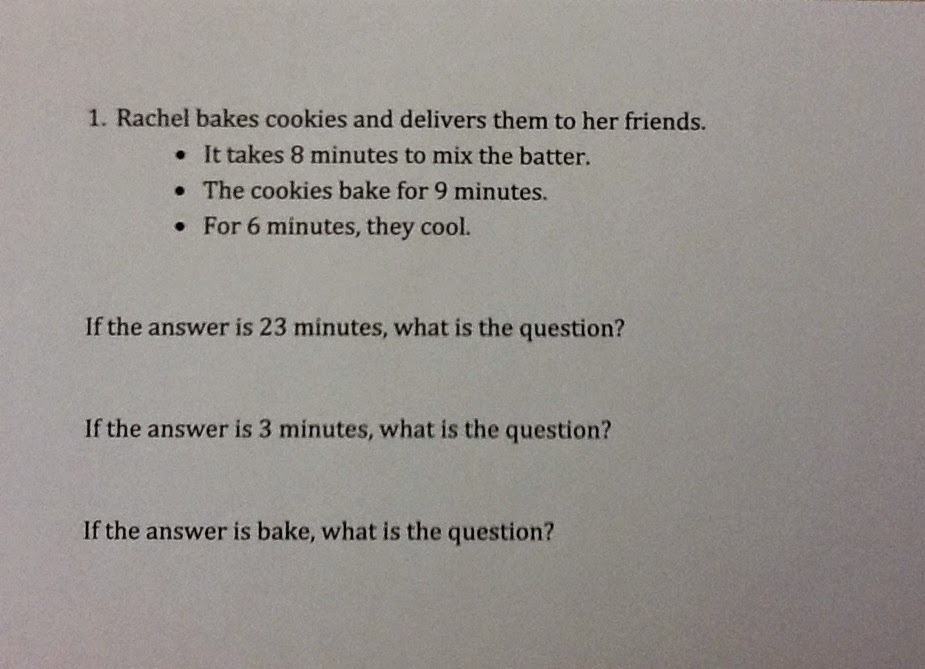
     Our grade 2 teachers showed me this problem.  They had copied it for their students to work on in a problem solving center:


     Here is one suggestion: take off the question and replace it with a notice and wonder prompt:

This automatically lowers the barrier to entry.  Another advantage to this approach is that the kids, through their wonderings, come up with questions of their own to solve.


Here's another:

As one teacher at my school puts it, when we ask kids to engage in tasks like this it forces them to, "Use muscles they're not used to using."
       I'm not arguing that the questions on these worksheets are especially compelling, or that we're eliminating pseudo-context.  But for teachers that need to plan and prepare for science, social studies, reading, and writing, as well as math, and who may not have the time to cover a file cabinet with post-its, or fill a tank with water, making some small changes to the worksheets they have on hand can sometimes make a big difference.

"...finally, in total, just be less helpful, because the textbook is helping you in all the wrong ways: It's buying you out of your obligation, for patient problem solving and math reasoning, to be less helpful."
   Dan Meyer,  Math Class Needs a Makeover

Saturday, February 14, 2015

100 Days In

On Monday you could sense something stirring in the air...


On Tuesday the wind shifted...


By Wednesday it was clear something big was coming...


And on Thursday the excitement reached a fever pitch...


Finally, it was Friday, and everybody let loose because...


     Last year's celebration was fun, but this year the teachers and kids really outdid themselves.

There were hats:

Grade 1

Grade 1

Grade 2.  10 stripes with 10 objects on each.  10 x 10 = 100!!

In Kindergarten:


We've come a long way since Day 39!


The kindergartners filled in a hundreds chart...

....then cut it apart and threw all the pieces in the air like confetti.

They also practiced their tallying skills.


The first graders sorted 100 objects:

How much money?

I got to bring my Legos to school!

Got a Jigglypuff card?

The second graders had fun in centers:


Kids in the upper grades also got into the act:

This game was originally called Total Ten.  The numbers in the squares were decimals.  The object was to capture 3 squares in a row that equaled 10.  I changed the decimals to whole numbers by whiting out the decimal points.
Congratulations to all the teachers and kids who made the 100th day so special.

Truth.


Saturday, January 31, 2015

Out of the Box

    One of the first things I did when I took over the position of math specialist at my school was take inventory of what had been left in my new room.  There was quite a collection gathering dust in the closets, cabinets and drawers, most of it dating back many years: office supplies, manipulatives, old textbooks and workbooks, files, games, flashcards, and measurement tools.  Some of it I tossed.  Some of it I distributed to teachers and classrooms.  The rest I kept.

A battered survivor of the purge.

     One day, looking for something to fill a few extra minutes with one of my basic skills students, I grabbed the game, opened the box, and gave it a try.

Roll 3 dice, two 1-6 number cubes and another with addition and subtraction symbols.  The die with the operations was missing, so I made a replacement.  Use them to create an addition or subtraction number model.   Find the sum or difference...
...and move a token (snail, frog, turtle, or snake)  around the game board from the start, through the swamp, to the lily pad at the finish.
     Simple.  I grew to love the game, and it soon became a stand-by.  It has many benefits:
  • Basic addition and subtraction fact practice
  • Counting with one-to-one correspondence
  • Identifying numbers as odd or even (If you land on a square that says "even" you roll a number cube.  If the result is an even number you move forward that many spaces; same for an odd number.)
  • Social aspects of a good, old-fashioned board game, including learning how to take turns, handle adversity, and be a gracious winner... or loser.  Because I don't let kids win.  Well, hardly ever.
 The game has one insidious aspect, the dreaded "Endless Loop":


Once you enter the loop, you need to keep going around and around until you land exactly on the exit.  Only then can you dash to the lily pad.  It can get very frustrating.

  Last week, I was playing the game with one of my grade 2 basic skills students.  She had traveled around the endless loop a few times, and her frog sat one square before the exit.  She picked up the dice, but before she rolled I stopped her, and asked a question it had never occurred to me to ask before:

   Me: What will you have to roll to land exactly on the exit?
   Her: A one.
   Me: Yes, a one.  How can that happen?  (I knew that a roll of 11 would also work, but that's not where I wanted to go.)
   Her: (silence)
   Me: Show me what the roll would have to look like for you to get a one.


It was fascinating  to watch her think through this task, turning the dice and working with her fingers until she found a combination that worked.

   Her (putting up two fingers and taking one down): 2 minus 1 equals one!
   Me (realizing I might be on to something): What else could you roll?

She continued  manipulating the dice and using her fingers to calculate.  I pulled out a whiteboard and started writing down what she told me.  I was hoping she would see a pattern, and use it to generate the rest of the combinations, but no go.  She got stuck with one more left to find.


She needed a lot of prompting to come up with the final combination...

...but then she saw it, and continued to generate more subtraction number sentences equal to one.


    The period was coming to a close, and we finished the game.  I put the whiteboard aside, with the intention of taking it out again at our next meeting and using it to help her dig through what she had discovered about differences equal to one.   And I understood that there were more benefits embedded in the seemingly simple game than I had realized.  I had been focused on content standards, and had overlooked the opportunities to engage students in practice standards; in this case, a nice combination of SMPs 1 and 7.
     I've written about games before; how they can be used and repurposed.  I'm glad my predecessor left Sum Swamp behind.  More importantly, I'm glad I held on to it.  I never could have imagined what would come out of that box.


Sunday, January 18, 2015

Noticing and Wondering: A Sampler

    It's hard for me to believe that I've spent most of my teaching career in complete ignorance of noticing and wondering.  This simple, elegant prompt has become an integral part of my practice, and its use is spreading throughout the school.  Here are some examples from the past few months:

Grade 5:

I snapped this picture in the teacher's lounge the Monday after Thanksgiving break.  Rich  put it up as a noticing and wondering math message.


It was clear that some of the responses were inspired by our continuing use of the pie-eating contest:
  • How many degrees are eaten?  How much of the pie is left in an angle?
  • How big is the missing piece?
  • Is 75 degrees eaten?
But many took a different direction:
  • How much did the pie cost?  What would be the unit cost for the one piece missing?
  • How many ingredients were used?  How many teaspoons of sugar?
  • How heavy is the pie?
  • What's the perimeter of the pie? 
  • Could you divide it in equal pieces?  Can you make it into a fraction, like 1/6?
  • Is it store bought? (Not overtly mathy, but I liked it!)
  • Why does it look like pac-man?

Grade 2:
     The second grade teachers have done a wonderful job incorporating noticing and wondering into their math message routine. 


     Instead of asking the kids to fill in the diagram and solve the problem, Maggie provided the answers and let them have at it.  Here's what came up:
  • In the two parts (45 and 25), the digits in the ones places are the same, while the digits in the tens places are different.
  • The two parts are odd, but when you add them together the total is even.
  • If you have a number and you add more to it, you get a higher number.
  • The cents symbol looks like a "c" with a line through it.

Grade 1:

     Theresa and I have been spending time with the first grade teachers and students talking about the importance of subitizing.  It made me happy to walk into Jen's room one morning and see what she had chosen for a warm-up activity:

I've been taking photos in the supermarket and downloading them into a folder on the school's shared drive for the teachers to use as subitizing prompts.


Jen recorded their responses,  The kids are getting really good at this!


Grade 5

    Last week I found myself staring down a guided group and a pile of  Magic Squares that I had found to help the kids practice adding fractions and mixed numbers.  I will admit that I had not put much thought into how I was going to present the task.

As I showed them the model, it struck me.  How about a simple, "What do you notice?  What do you wonder?"


      Asking the kids to notice and wonder allowed them all to enter the task at the ground floor.  They noticed the boxes, some empty and some filled; they noticed the two mixed numbers and the one whole number; they noticed the tic-tac-toe-like configuration.  They wondered what might be magical about the 40 1/2; they wondered whether some mathematical operations might be involved.  After only a few minutes of discussion, they were ready to go,

I highly recommend this activity.  It hit some kind of 5th grade sweet spot. 

     Noticing and wondering has many benefits:

  • It's easy for a teacher to remember and can be used in many situations.
  • There are no right or wrong answers, and nothing to solve.  It's anxiety-free.  
  • It's a one-size-fits all prompt. It's as simple or challenging as the individual child that responds.
  • It can be a valuable formative assessment tool, and a window into the minds of our students.
  • It can be practiced, and kids can get better at it.  
  • Kids can utilize it as a protocol for understanding a problem before they go about deciding how to solve it.
Noticing and wondering is all the rage at my school.  How are you using it at your school?


Sunday, January 11, 2015

Functional Misses

     What do you do when a student in class raises his or her hand...and then proceeds to give a wrong answer?  Do you:
  • Call on another child to provide the correct answer under the guise of "helping" the confused student?
  • Stop and intervene with the individual student while the rest of the class sits idly by and waits for you to finish?
    These are the two most frequent responses I observe (and have used myself).   As teachers we know that our students will give wrong answers.  And as teachers we know that there is a lot more riding on our response than the misunderstanding of a concept or procedure.  There are emotional consequences as well.  If we're not careful, the way in which we handle wrong answers can effect a child's perception of himself or herself as a learner, cause embarrassment, and lead to an unwillingness to contribute to and participate in class activities.  So what can we do?
    As with many things, we can look for answers to the NBA.  Specifically Houston Rockets extraordinary two- guard, James Harden.

Harden currently leads the league in scoring, and possesses the best beard in professional sports.

      In a recent article in Grantland, Kirk Goldsberry deconstructs Harden's scoring genius.  He finds there's more to Harden's offensive game than his shooting prowess and uncanny ability to draw fouls and get to the line.   He explains:

  But even when his attempts fail, they have a chance of succeeding. The entropy from his slashing drives, which scramble defenses, enables his teammates to slip into great rebounding positions. Not all missed shots are created equal, and sometimes they function a lot like inadvertent passes or shot-clock reset buttons.

 Goldsberry calls these "functional misses".


    In Goldsberry's example (above), Harden drives down the lane and misses the lay-up.  A teammate, however, is in perfect position for a put-back slam.  Functional miss.
   Is it possible to put this notion into practice in the classroom?  The day after reading the Grantland piece, I was helping a guided group of struggling fifth graders work through fraction addition at Rich's back table.

Hmmm.  Unlike denominators.
   
The kids dutifully took out their multiplication grids and found common multiples for 2 and 3.
  
We settled on 6.   So far, so good!

We converted 1/2 into an equivalent fraction, 3/6.  
   
     It was at this point that a student, I'll call him Jeremy, raised his hand.  Jeremy is new to our school.  His math skills seem shaky, which is why Rich decided to have him work with me in the guided group.  I was glad he felt comfortable making a contribution, and was curious to know what he had to say.
    "That's a mixed number!" he exclaimed.
    "Where?" I asked, hoping he was referring to the sum of the two fractions.  Was it possible he was two steps ahead of us?
    "Three-sixths," he said, pointing to the fraction on his whiteboard.  "Three-sixths.  That's a mixed number."
    I could sense the unease of the rest of the group.  We had spent several weeks talking about improper fractions and mixed numbers, and I was sure they knew he was wrong.  I decided to press him a little.
   "What makes it a mixed number?" I asked
   "The numerator and the denominator got bigger," he told me.
     The moment of truth.  The time to make one of the hundreds of decisions, both big and small, a teacher has to make each day, every day.  What size decision was this one?  What would you do?
   
     I decided to highlight what was correct, ignore the mistake, and move on.  Perhaps I could turn it into a functional miss.
    "What you said about the numerator and denominator getting larger is correct, Jeremy," I responded.  "Let's work on finishing the problem."


We turned 2/3 into 4/6, and then added the fractions together to get 7/6.
     The kids jumped all over it.   "That's an improper fraction, Mr. Schwartz!"
     "Yes it is," I said.  "Can you say more about 7/6?"
     They didn't let me down.
    "6/6 is 1 whole, and there 1/6 left.  That makes 1 1/6!"

Look at that!
     "There's Jeremy's mixed number!" I said, addressing everyone at the table but looking right at him.  "1 1/6.  A whole number and a fraction.  That's what makes a mixed number."
      Did I make the right decision?  I'm sure there are others I could have made, and maybe some would have been better.  I know I have to spend some time with Jeremy, who is likely in need of some intervention.  But in that moment, Jeremy had the correct answer.  Because inside of every wrong answer, there's a correct answer just waiting to get out.  If we can find the right question, we turn it into a functional miss.
    As fate would have it, that night the Rockets destroyed my sorry Knicks.  James Harden went off for 25 points and 9 dimes in just 30 minutes.  As much as it hurt, I had to smile.