Some teachers wonder then what their role in the classroom could be if it is not focused on demonstrating and explaining strategies to students and monitoring students' progress in using these strategies.
-Susan B. Empson and Linda Levi
I'm late to the math party. I came to my current position as a K-5 specialist from a general elementary education background. I taught all subjects during the 23 years I spent in my grades 2 and 3 classrooms, and math didn't stand out in any significant way. I knew who
Marilyn Burns was, but if I had ever met the luminaries that my colleagues in the MTBoS speak of so highly, people like
Van de Walle and
Fosnot and
Kamii and
Richardson, for example, it was long ago in teacher school, and I'd certainly forgotten who they were. So I play catch up.
Cognitively Guided Instruction (CGI) is something that, upon hitting the MTBoS, I heard referred to again and again. Glowingly. Reverently. And so this summer I decided to find out what the fuss was all about. I wanted to explore
Extending Children's Mathematics: Fractions and Decimals, and put together a small, very informal book study PLC composed of our two grade 4 teachers and my former partner and fellow specialist Theresa. We met twice in July and once in August to discuss our reading assignments and share the work we had done.
 |
| Kudos to my colleagues who gave up some of their summer evenings to participate in this project. |
It was an incredible experience, and we learned so much from the book and from each other. We increased our own content knowledge, and are now armed with some tools that I hope we can employ to better analyze student work.
A few weeks ago I came across a set of photos I had taken late last school year of responses to an item on a grade 5 unit assessment. The problem seemed pretty simple, and I was struck by the many different ways students had attempted a solution. At the time I was ignorant of CGI, but looking at them now through a CGI lens I can better understand and describe what's happening.
 |
The student multiplied 4 x 2 and 4 x 5/8 and added the two products together. This was a good illustration of the distributive property of multiplication over addition. This student was also able to use relational thinking to express 20/8 as 2 1/2. He is able to decompose 20/8 into 8/8 + 8/8 + 4/8. He understands that 8/8 equals 1 whole, and that 4/8 is equal to 1/2.
|
The students who got it right were almost uniform in implementing the above strategy, although there were some outliers:
 |
Convoluted, but it worked. This student is also able to use relational thinking to express 2 5/8 as 21/8 and 4 as 32/8. Why did he feel it necessary to have common denominators?
|
But what had really caused me to stop and take some pictures was the many and varied ways that students had managed to be
wrong.
 |
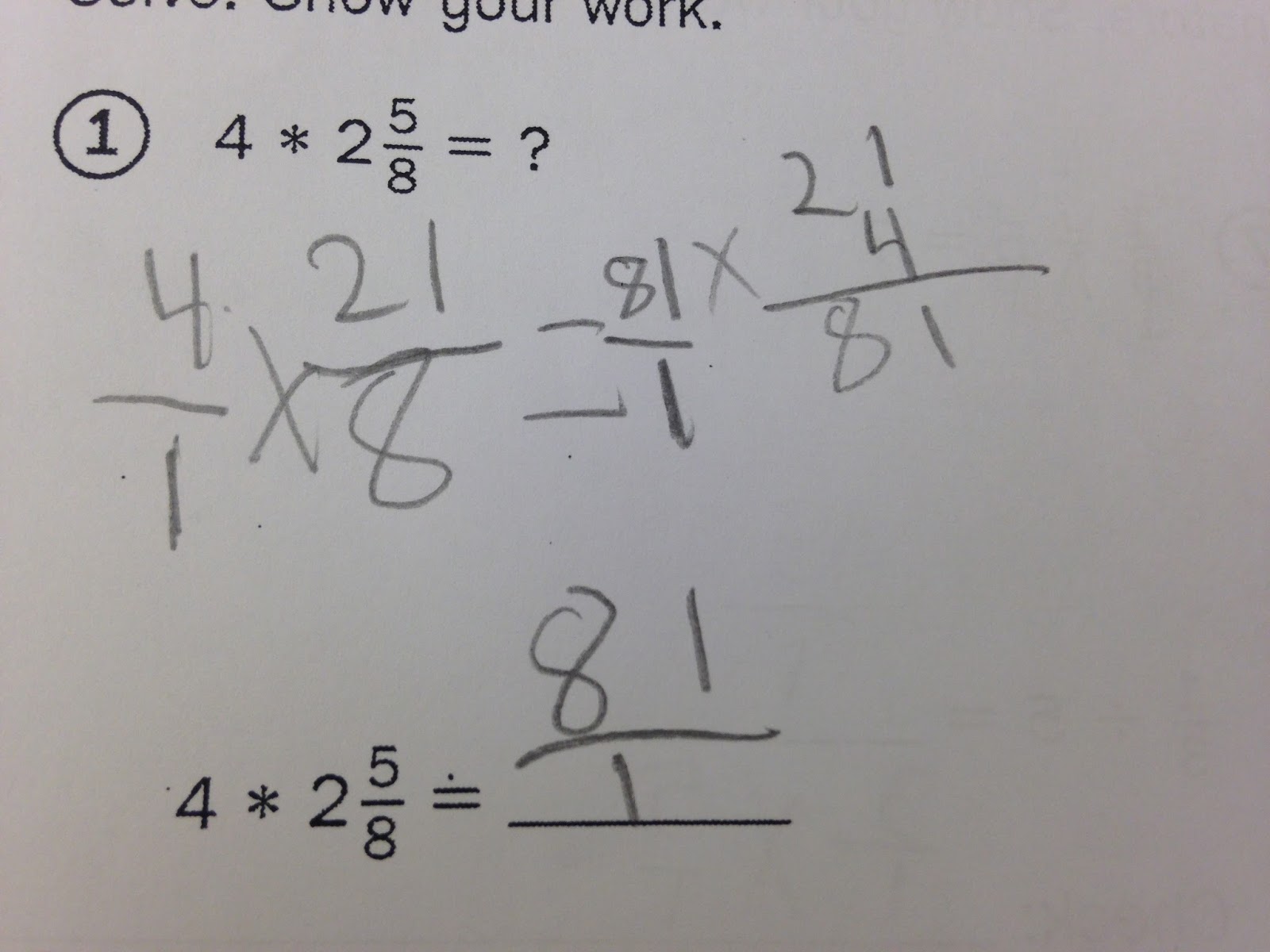
This student converted 2 5/8 into an improper fraction. Did he really understand why 2 5/8 was equal to 21/8 or was he just following a procedure: multiply the denominator by the whole number and then add the numerator? The multiplication across the numerators is incorrect. Careless mistake or confusion about the identity property of multiplication?
|
 |
No question here. Issues with the identity property of multiplication.
|
 |
This was a common mistake: multiplying 4 x 2 then just adding the 5/8. This student has used an equal sign to separate the expressions, rendering an incorrect equation. 4 x 2 does not equal 8 + 5/8.
|
 |
This is diagrammed as if the student were multiplying 42 x 5/8. When multiplying 5/8 x 4 the student flipped the 4 into 1/4. Perhaps he had heard something about "invert and multiply"? However he did not do this when multiplying 5/8 x 2. In the top left corner he is adding his two products, but how he got 10/628 is a mystery.
|
 |
With no actual work, I deduce that this student multiplied 4 x 2 to get 8, then, in the mixed number, multiplied 2 x 5 and 2 x 8 to get 10/16. He finished by adding 8 and 10/16.
|
 |
At first look it appears as if this student multiplied 4 by every digit he saw in the mixed number. How did he get 160? By multiplying 8 x 20?
|
These fifth graders are now off to middle school. But their work remains, and looking at it through the lens of what I've learned this summer is going to inform what I do, not only with the new batch of fifth graders, but with all math learners in our school. If I read my CGI right, these kids are victims of an over-reliance on procedural memorization. They have bits and pieces of algorithms that they can't put together because they have weak conceptual underpinnings. They're easy to spot. However it's possible that many of the kids who
did get the correct answer also have shaky conceptual foundations, but are just better at memorizing a procedure. How will we find them?
CGI argues for a decrease in the amount of time teachers spend, "demonstrating and explaining computation and problem-solving strategies to students." Instead, teachers are encouraged to allow their students' intuitive strategies to emerge first. "Children have some conceptually sound understanding of fractions, even before instruction," Empson and Levi write, "(but they) can learn to ignore this understanding in favor of models introduced in school that portray fractions in narrow ways."
This is a tremendous shift away from the traditional "I do, we do, you do" model, and entails teachers taking on a different role. "
This new role," the authors of CGI explain, "Centers on helping students communicate strategies to other students, directing questions to specific students to help them draw connections between these strategies and more basic strategies, introducing equations to represent students' strategies, and highlighting the fundamental properties of operations and equality that that underpin these strategies."
That's a lot to ask. But I've read the book and I'm a believer. Let's roll up our sleeves and get to work.